 Greywire
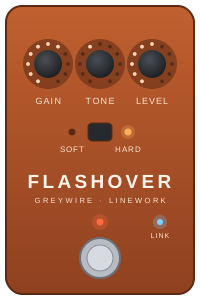
Linework · Distortion / overdrive
Flashover
An analog distortion that goes from light overdrive to full saturation, with knobs your setlist can turn for you.
Prototyping
A flashover is what happens when voltage climbs so high that electricity jumps the gap it's supposed to stay behind: a signal pushed past its limits.
The sound
Flashover is built on a classic single op-amp gain stage with clipping diodes, the kind of circuit behind decades of great records, plus a tone control for shaping the top end.
- Soft or Hard clipping. A button swaps between germanium diodes for a smoother, looser breakup and silicon diodes for a tighter, more aggressive one.
- Tone blends from a darker, bass-keeping filter to a brighter one.
- Fully analog audio. The digital parts only set the controls; your signal never gets converted.
Controls
| Gain | How hard the signal is driven, from light overdrive to full distortion |
|---|---|
| Tone | Darker to brighter |
| Level | Output volume |
| Soft / Hard | Chooses the clipping diodes, with an LED for each |
| Footswitch | Effect on and off, with an On LED |
| Link LED | Lights when Flashover is linked to Switchyard |
Gain, Tone and Level are endless knobs with LED rings. When Switchyard changes a setting, the ring shows the new position, and turning the knob carries on from there. No knob is ever pointing at the wrong value.
Linked to Switchyard
On its own, Flashover is a normal distortion pedal. Linked to Switchyard, it switches on, sets all three knobs and picks its clipping mode for every part of every song.